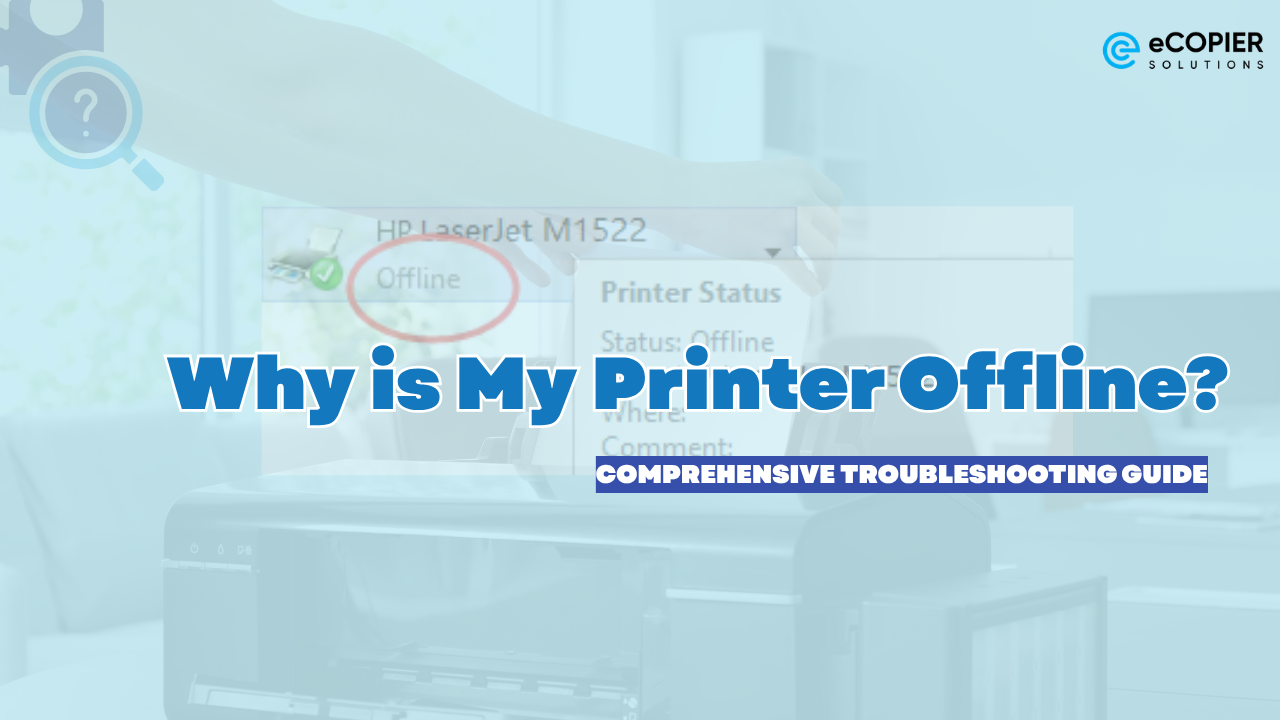
We all dread the"printer offline" message popping up on the screen. While the problem can seem daunting, the good news is that the majority of the errors stem from easily identifiable and solvable issues.
Read on to this comprehensive guide that will demystify why your printer might be showing an offline status, provide step-by-step instructions to get it back online, and offer strategies to prevent future connectivity problems.
We'll explore everything from simple physical connections to more complex network configurations, ensuring you can tackle this common printing headache with confidence.
Overview: Why Is My Printer Offline?
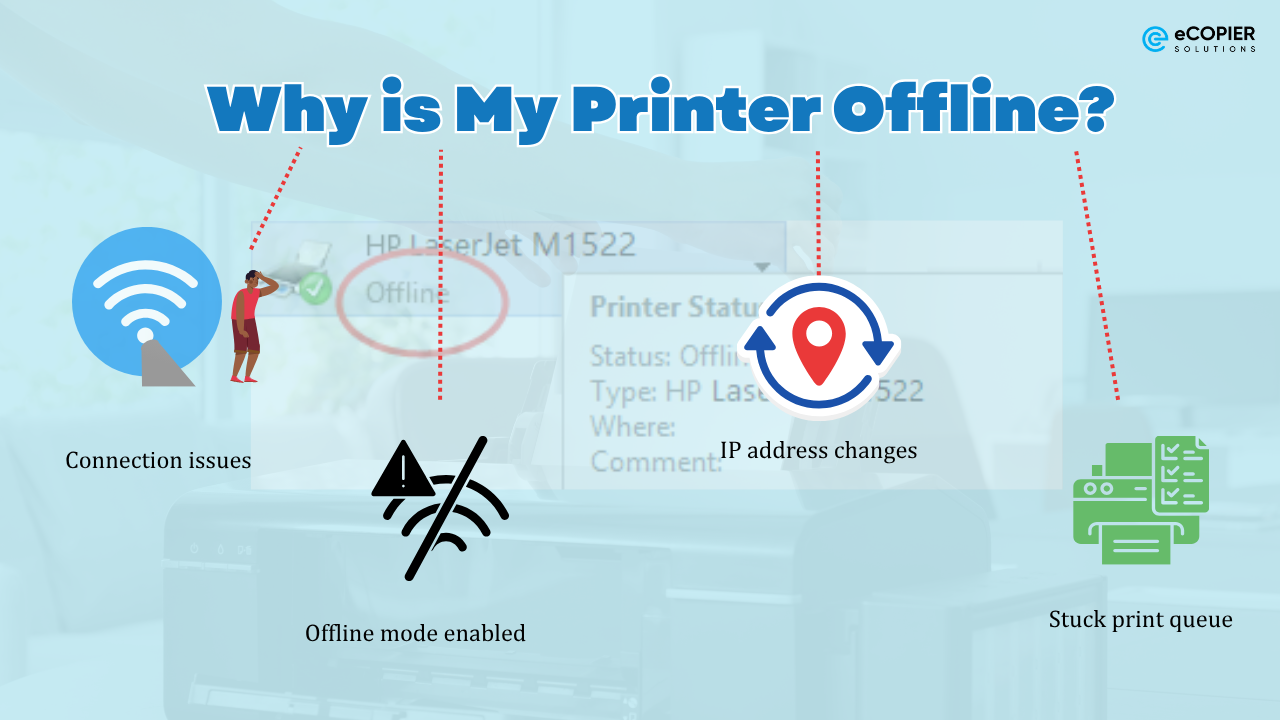
If you just need a fast answer, here are the most common reasons your printer shows offline:
- Connection issues: The printer isn’t properly connected to Wi-Fi, USB, or the correct network.
- Offline mode enabled: Your computer may have “Use Printer Offline” turned on.
- Outdated drivers: Old or corrupted drivers prevent proper communication.
- Stuck print queue: A failed job is blocking new print requests.
- Spooler service errors: The system managing print jobs has stopped working.
- IP address changes: Your wireless printer’s network address has changed.
Quick takeaway:
In most cases, the issue comes down to connection problems or simple settings and not a broken printer.
If you’re unsure where to start, begin with:
- Restarting your printer and router
- Checking your network connection
- Clearing the print queue
This quick checklist resolves the majority of offline printer issues without needing professional help. Need more explanations? Read on to dive deeper into it.
What Does “Printer Offline” Actually Mean?
To put it simply, the "printer offline" message, it signifies a breakdown in communication between your device and the printer.
Essentially, your computer is unable to send commands or data to the printer because it believes there is no active connection.
This doesn't necessarily mean the printer itself is broken or powered off; it could be switched on and seemingly ready, but the digital pathway between it and your computer is interrupted.
Think of it like trying to have a conversation with someone whose phone has lost its signal: the person is there, but the message can't get through. This lack of communication is the core of the "printer offline" status.
Common Reasons Your Printer Is Offline
Understanding the potential causes is the first step toward resolution. While the specific culprit can vary, most "printer offline" errors fall into a few key categories.
For instance, the average office employee wastes up to 22 minutes per week dealing with printer-related issues, a significant portion of which can be attributed to connectivity problems like an offline status.
Here are some of the most common issues:
1. Connection Problems
Connectivity issues are the most frequent reason a printer offline error appears.
This could be due to several reasons such as:
Physical Cable Disconnection
For printers connected via a USB cable, it might simply be loose, unplugged at either end, or suffer from cable damage.
Similarly, if you use an Ethernet cable for a wired network connection, ensure it's securely plugged into both the printer and your Wi-Fi router or switch.
Wireless Connectivity Failure
Wireless printers are particularly susceptible. The printer might have lost its Wi-Fi connection to your Wi-Fi network, perhaps due to a temporary Wi-Fi router outage, a change in your network name or password, or simply being too far from the router.
Incorrect Network Association
In environments with multiple networks, the printer might have connected to the wrong Wi-Fi network, preventing communication with your primary computer network.
Router Issues
Problems with your Wi-Fi router itself, such as a need for a reboot, network congestion, or outdated firmware, can disrupt communication for all connected devices, including your printer.
2. Printer Is Set to “Use Printer Offline.”
This is a peculiar but common setting that can easily cause a printer offline error. On Windows operating systems, there's a specific option within the printer's properties that, when enabled, tells your computer to spool all print jobs locally rather than sending them directly to the printer.
This is intended as a failsafe for when the printer is truly unavailable, but if it's accidentally checked, your computer will continue to queue jobs indefinitely, believing the printer is offline.
3. Outdated or Corrupt Drivers
Printer drivers are essential software components that act as translators, allowing your operating system (like Windows or macOS) to communicate effectively with your specific printer model.
If these printer drivers become outdated, corrupted, or are incompatible with a recent system update, the communication channel breaks down, often resulting in the printer appearing printer offline.
This can happen after a Windows Update, a conflict with other installed software, or if the drivers haven't been updated since the printer was first installed.
4. Print Queue Is Stuck
The print queue is a holding area for all the print jobs that your computer is sending to the printer. If one particular print job fails, perhaps due to a formatting error, a corrupted document, or a sudden disconnection, it can sometimes halt the entire queue.
This means all subsequent print jobs will remain stuck behind the problematic one, and the printer may appear printer offline because it's not receiving new instructions.
Pro-Tip: You might want to check for old, stuck documents lingering in the print queue window.
5. Printer Spooler Service Issues
The Print Spooler service is a crucial background process on Windows operating systems that manages the flow of print jobs from applications to the printer. It queues, schedules, and sends documents for printing.
If this Print Spooler service crashes, stops unexpectedly, or encounters an error, it can prevent any new print requests from being processed, leading to the printer's offline status.
This is a common culprit, especially on Windows OS or Windows 11 machines.
6. IP Address Changes (For Wireless Printers)
Wireless printers are assigned an IP address by your Wi-Fi router to communicate on your network. This IP address is typically assigned dynamically via DHCP (Dynamic Host Configuration Protocol).
When your Wi-Fi router restarts, or after a certain period, the router might assign a new IP address to your printer.
If your computer still tries to send print data to the old IP address, it won't find the printer, resulting in the printer offline error. This is especially common if your printer frequently disconnects and reconnects to the Wi-Fi network.
An IP address conflict, where two devices are assigned the same address, can also cause communication issues.
Step-by-Step Fixes You Can Try at Home
When your printer stubbornly remains printer offline, a systematic approach can help you diagnose and resolve the issue. These steps start with the simplest checks and progress to more involved troubleshooting.
Step 1: Check the Basics
Before diving into software settings, ensure all physical and power connections are sound.
- Power On: Verify that your printer is powered on and that its power switches are in the correct position. Look for indicator lights that confirm it's active.
- Sleep Mode: Many printers enter sleep mode to conserve energy. Try waking it up by pressing a button on the printer or sending a new print job. Sometimes, a printer in deep sleep might appear unresponsive.
- Printer Status Lights: Examine the printer status lights. Blinking or solid red lights often indicate an error, such as a cartridge issue, low ink, or a paper jam, which can indirectly affect its ability to print and be detected. While not always a direct cause of being printer offline, addressing these can resolve underlying issues preventing communication.
- Connections:
- USB: Ensure your USB cable is firmly connected to both the printer and your computer's USB port. Try a different USB port on your computer and inspect the USB cable for any visible signs of cable damage.
- Ethernet: If using an Ethernet cable, confirm it's securely seated in both the printer and your router/switch.
- Wireless: Check your printer's display or network status lights to confirm it has a strong Wi-Fi connection to your Wi-Fi network.
Step 2: Restart Everything
A simple restart can often resolve temporary glitches in any of the connected devices. This is a universal troubleshooting step for most tech issues and can quickly bring your printer back printer online.
- Turn off your printer: Use its power button to shut it down completely.
- Restart your computer: Reboot your Windows OS machine or Mac.
- Restart your Wi-Fi router: Unplug your Wi-Fi router from the power source, wait for about 30 seconds, and then plug it back in. Allow it a few minutes to fully boot up.
- Power on the printer: Once your computer and router are back online, turn your printer back on.
- Check the status: See if your computer now recognizes the printer as printer online.
Step 3: Set Printer to Online Mode
If your printer is stuck in offline mode due to a software setting, you can manually change it.
For Windows Users:
- Open the Control Panel. You can search for it in the Windows search bar.
- Navigate to Devices and Printers.
- Locate your printer in the list. Right-click on it.
- Select "See what’s printing" to open the print queue window.
- In the print queue window, click on the "Printer" option in the menu bar.
- Ensure that the "Use Printer Offline" option is unchecked. If it is checked, uncheck it.
You may need to restart the Print Spooler service (covered in Step 6) for this change to take effect immediately.
For macOS Users:
macOS typically manages printer status more dynamically. If your printer appears offline, the issue is usually related to connectivity or drivers rather than a specific "offline" setting. You can check the printer status in System Settings (or System Preferences on older versions like OS 10.6.8).
Step 4: Clear the Print Queue
A stuck print queue can prevent new print jobs from being sent. Clearing it can resolve this blockage.
Open the Print Queue: Follow the steps in Step 3 to open the "See what's printing" window.
Cancel All Jobs: In the print queue window, go to the "Printer" menu bar and select "Cancel All Documents" or "Cancel All Jobs."
Confirm Cancellation: You might need to confirm the cancellation.
Restart Printer and Spooler: After clearing the queue, restart your printer and the Print Spooler service (as described in Step 6) for good measure.
Step 5: Update or Reinstall Drivers
Outdated or corrupt printer drivers are a very common cause of printer offline errors. Ensuring you have the latest, correct drivers is crucial.
- Identify Your Printer: Know your exact printer manufacturer and model printer (e.g., HP Envy 5546, Canon MP600).
- Visit Manufacturer's Website: Go to the official support website for your printer manufacturer.
- Download Latest Drivers: Navigate to the "Support" or "Downloads" section and search for your specific model printer. Download the latest recommended printer drivers for your operating system (e.g., Windows 11, OS Ventura).
- Uninstall Existing Printer (Recommended): Before installing new drivers, it's often best to remove the old printer from your system.
- Windows: Go to Control Panel > Devices and Printers, right-click your printer, and select "Remove device."
- macOS: Go to System Settings > Printers & Scanners, select your printer, and click the "-" button.
- Install New Drivers: Run the downloaded driver installer. Follow the on-screen prompts carefully, paying attention to connection type (USB, Wi-Fi, Ethernet) and how you want to connect your printer.
- Reinstall Printer: Once the drivers are installed, add your printer again through your operating system's printer settings.
Step 6: Restart the Print Spooler
If you're on Windows, the Print Spooler service is a critical component. Restarting it can resolve many printing issues.
- Open Services: Press the Windows Key + R to open the Run dialog box. Type services.msc and press Enter.
- Locate Print Spooler: Scroll down the list of services and find "Print Spooler."
- Restart the Service: Right-click on "Print Spooler" and select "Restart." If "Restart" is unavailable, select "Start."
- Set Startup Type (Optional but Recommended): While you're there, right-click "Print Spooler" again, select "Properties," and ensure the "Startup type" is set to "Automatic." Click "Apply" and "OK."
- Check Printer Status: After restarting the service, check if your printer is now printer online.
Step 7: Check Your Network (For Wireless Printers)
For wireless printers, network configuration is key.
- Same Network: Ensure both your printer and your computer are connected to the exact same Wi-Fi network. Sometimes, a device might connect to a guest network or a different band (2.4GHz vs. 5GHz) unintentionally.
- Reconnect Printer: On your printer's control panel, navigate to the network settings and try reconnecting it to your Wi-Fi network. You may need to re-enter your Wi-Fi password.
- Static IP Address: If your printer frequently goes offline, assigning it a static IP address can prevent future conflicts. You typically do this through your Wi-Fi router's administration interface.
- Find your printer's current IP address (often by printing a network configuration page from the printer's menu), then reserve that IP address for the printer's MAC address within your router's DHCP settings.
- Once the IP is reserved, you might need to update the printer's connection details on your computer or reinstall the printer.
- Network Reset: If experiencing persistent connectivity problems, consider performing a network reset on your computer and then reconnecting all devices to the Wi-Fi network.
When to Call Professionals
If you've meticulously followed all the preceding steps and your printer remains stubbornly printer offline, it might be time to seek expert assistance. There are several reasons why professional help is beneficial:
- Complex Network Configurations: Issues like IP address conflicts, firewall misconfigurations, or problems with network hardware (routers, switches) can be complex to diagnose and resolve for the average user.
- Advanced Driver Issues: Sometimes, driver conflicts are deep-seated and require specialized knowledge to untangle.
- Firmware Issues: While we'll discuss firmware updates later, certain persistent firmware issues might require professional tools or guidance from the printer manufacturer.
- Hardware Malfunctions: While less common as a cause for "offline" status, if the printer itself has a hardware fault, professional diagnostics are needed.
For these situations, reaching out to your printer manufacturer's customer support team or a qualified IT support professional can save you significant time and frustration.
They have access to advanced diagnostic tools and can provide tailored solutions, especially for business-grade printers or complex home office setups.
Many manufacturers offer dedicated FAQs & Troubleshooting sections and support articles on their websites, and community forums like the Apple Support Community can also offer valuable peer support.
Preventing Printer Offline Issues
The best way to deal with a printer offline error is to prevent it from happening in the first place. Implementing a few proactive habits can significantly improve your printer's reliability and ensure it’s always online when you need it.
- Printer Drivers: Regularly check your printer manufacturer's website for updated printer drivers, especially after significant operating system updates like Windows Update or macOS version upgrades.
- Operating System: Ensure your operating system is up-to-date. Windows Update and macOS updates often include patches and improvements that can affect hardware compatibility and performance. For ARM PCs, keeping the OS optimized is also critical.
- Maintain Stable Connectivity
- Reliable Router: Invest in a quality Wi-Fi router and ensure it's placed in a central location to provide a strong signal throughout your home or office.
- Wired Connections: If possible and practical, using an Ethernet cable for your printer can provide a more stable and reliable connection than a wireless connection, as it's less susceptible to network congestion or signal interference.
- Static IP Addresses: For wireless printers, consider assigning static IP addresses (as mentioned in Step 7) to prevent the printer from losing its network identity after router reboots.
- Schedule Regular Maintenance
- Firmware Updates: Many printers receive firmware updates from the printer manufacturer that can improve performance, fix bugs, and enhance security. Check your printer's settings or the manufacturer's website periodically for these updates. Firmware issues can sometimes manifest as connectivity problems.
- Physical Cleaning: Dust and debris can accumulate in printer mechanisms over time, potentially causing mechanical issues that might indirectly affect communication. Follow your printer manufacturer's guidelines for cleaning.
- Ink/Toner Levels: While not a direct cause of being printer offline, critically low ink or toner can halt printing, and users may mistakenly attribute it to an offline status. Ensure you have adequate supplies.
Final Thoughts
Experiencing a printer offline error can be a significant inconvenience, but as we've explored, it's rarely an insurmountable problem. Most often, the solution lies in meticulously checking physical connections, restarting devices, ensuring the correct software settings are applied, and verifying your network's stability.
Need Reliable Help With Your Printer?
If your printer is still offline after troubleshooting, or if you want a more reliable and efficient setup for your home or office, it may be time to get expert support.
At eCopier Solutions, we help businesses eliminate printer issues, improve workflows, and choose the right equipment without overspending. From diagnosing persistent problems to optimizing your entire printing environment, our team makes the process simple and stress-free.
Instead of spending hours troubleshooting, get a solution that works.
A quick consultation can save you time, reduce downtime, and ensure your printer setup runs smoothly every day.









.webp)



.png)