

You may be asking when was the copy machine invented and expecting a simple answer. But the real story has a bit more history behind it. One moment gave us the process behind modern copying, while another helped turn that idea into an office tool that businesses could use every day.
In this article, we’ll explain when the copy machine was invented, who invented it, and why the Xerox 914 changed office work. We’ll also connect early copy machine history to the modern copiers businesses use today.
When Was the Copy Machine Invented?
The copy machine was invented in 1938, when Chester Carlson created the xerography process. That is the year most people point to when they talk about the invention of the modern copy machine.
But 1959 is also important. That was the year Xerox introduced the Xerox 914, the first widely successful plain-paper office copier. This machine helped turn copying from a slow or limited process into something offices could use every day.
Here is the easy way to remember it:
- 1938 = invention of xerography
- 1959 = first widely successful plain-paper office copier
This is why you may see both dates online. One date points to the invention behind photocopying. The other points to the machine that helped bring copying into normal office life.
Okay, now let’s break it down further.
Who Invented the Copy Machine?
Chester Carlson invented the process that led to the copy machine. He wanted a better way to copy documents because copying by hand or using older methods was slow and often frustrating.
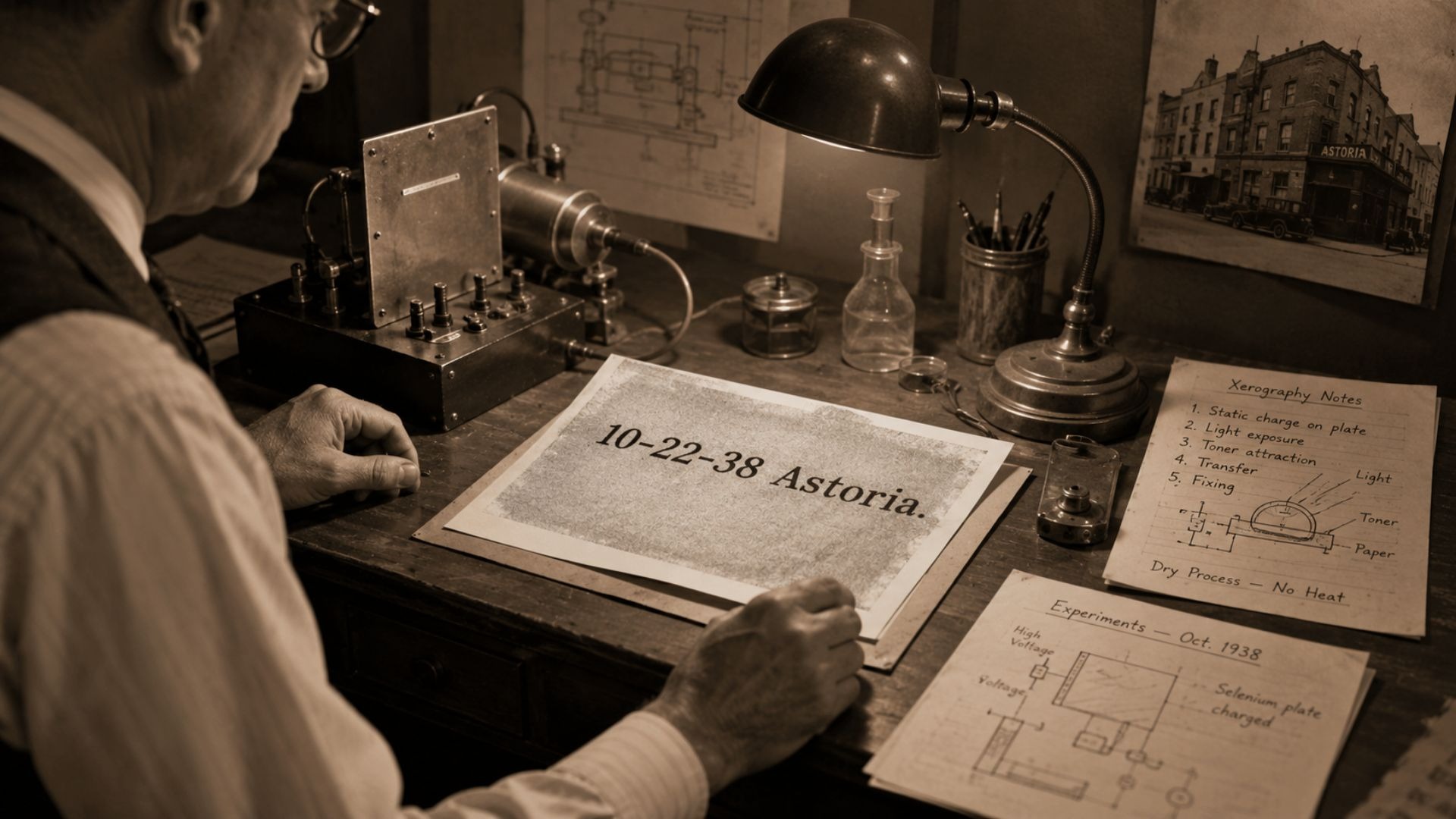
His first successful copy was made in Astoria, New York, in 1938. The first copied text was “10-22-38 Astoria,” which marked the date and place of the breakthrough.
Carlson did not just invent another office tool. He created a process that later changed how offices, schools, law firms, government offices, and businesses copied and shared documents. His work became the base for xerography, which made dry copying possible.
Why the Xerox 914 Changed Office Copying
The Xerox 914 changed office copying because it made plain-paper copying much easier for everyday use. Before it arrived, copying could be slower, messier, or less practical for busy offices.
The Xerox 914 was the first successful automatic plain-paper copier. It got its name because it could handle paper up to 9 x 14 inches. According to The Henry Ford, the machine weighed 650 pounds and made one copy every 26 seconds, which shows how large and mechanical early office copiers were compared with today’s machines.
Plain copy machine paper was part of what made the Xerox 914 so useful. Offices did not need a special or awkward process for every copy. They could place a document on the machine and get a usable copy with far less effort than before.
A Short Copy Machine History Timeline
Copy machine history is easier to understand when you see the main steps in order. The early machines were not as simple as the copiers people know now.
For example, early photocopiers introduced in 1949 needed 14 steps, took 45 seconds to make one copy, and could not make more than about 12 copies from one exposure.
These are the key moments to know:
This timeline shows why the copy machine was not just one sudden invention. It was a process that grew from one breakthrough into a major office tool.
What Came Before Modern Copy Machines?
Before modern copy machines, such as MFPs, people used tools like carbon paper, mimeographs, duplicators, and photostat machines. These tools helped people make copies, but they were not always fast or simple. Some methods needed special paper or supplies. Others were messy, slow, or hard to use for a large number of documents.
They worked for certain tasks, but they were not ideal for a busy office that needed fast, clean, repeatable copies. That is why the copy machine was such a major step forward. It made document copying easier for everyday teams.
How Copy Machines Changed Office Work
The copy machine changed more than printing. It changed how people shared records, forms, memos, reports, contracts, classroom materials, and office files.
Before the Xerox 914, the average business copier made only 15 to 20 copies per day. The Xerox 914 averaged about 2,000 copies per day, around 100 times more than the average business copier at the time.
These are the main ways copy machines changed office work:
- Faster document sharing
- Easier record keeping
- More copies for meetings, clients, and teams
- Less manual copying work
- Better support for law firms, schools, medical offices, and corporate teams
- More need for service, toner, maintenance, and machine uptime
In some offices, a copy machine operator helped run larger or busier copy rooms. As copying grew, reliability became just as important as speed.
How eCopier Solutions Connects to Today’s Copier Needs
Copy machines have changed a lot since 1938 and 1959, but we believe businesses still want the same basic outcome, which is fast, reliable document work with fewer interruptions.
At eCopier Solutions, we help businesses lease copiers and printers with support, toner, maintenance, and service under one plan. From our experience, choosing the right copier setup can make a big difference in day-to-day operations.
Businesses also need to compare copy machine brands, copy machine size, print volume, color needs, and service support before choosing the right setup. That is why we focus on helping businesses find reliable equipment and the right support, so their teams can stay productive and keep work moving.
Our support can help with:
- Avoiding copier downtime
- Not running out of toner
- Getting help when a machine stops working
- Choosing the right copier for the office
- Keeping printing and copying simple
When we look at the history of the copy machine, one thing becomes clear. Offices have always depended on fast document work. Modern businesses still need that same dependability, just with better service, smarter machines, and support that feels easier to manage.

FAQs
How Does a Copy Machine Work?
A copy machine works by using light, static electricity, toner, and heat to copy text or images onto paper. The machine scans the original document, transfers the image with toner, and then uses heat to bond the toner to the page.
Where Is a Copy Machine Near Me?
If your business needs a copier or printer, eCopier Solutions serves companies from its New York office at 100 Park Avenue, 16th Floor, New York, NY 10017. We provide copier and printer leasing, service, toner, and maintenance.
For a one-time copy, a library or print shop may work. But for regular business use, leasing a copier is usually the better long-term solution.
Did They Have Copiers in the 70s?
Yes, they had copiers in the 70s. By that time, copiers were already used in many offices, and the technology was becoming faster and more common.
Who Invented the Copy Machine?
Chester Carlson invented the process that led to the copy machine. He created xerography in 1938, which became the base for modern photocopying.
What Is the Old Name for Copier?
Older names and related terms for copier include photocopier, duplicator, photostat machine, and Xerox machine. “Xerox machine” became common because Xerox helped make office copying popular.

.jpg)



.webp)

.png)


